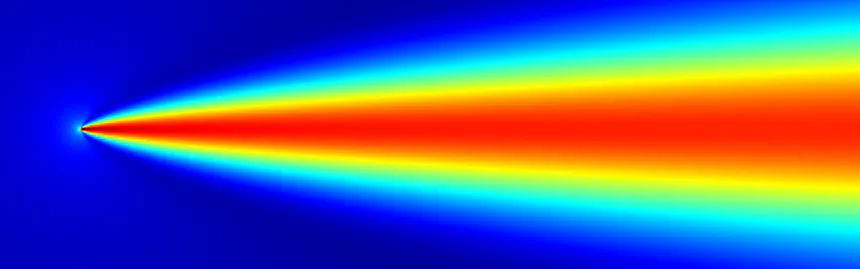
 Wake behavior of a steady Navier–Stokes solution with zero velocity at infinity
Asymptotic behaviour of solutions to the stationary Navier–Stokes equations in two-dimensional exterior domains with zero velocity at infinity
Abstract
We investigate analytically and numerically the existence of stationary solutions converging to zero at infinity for the incompressible Navier–Stokes equations in a two-dimensional exterior domain. Physically, this corresponds for example to fixing a propeller by an external force at some point in a two-dimensional fluid filling the plane and to ask if the solution becomes steady with the velocity at infinity equal to zero. To answer this question, we find the asymptotic behavior for such steady solutions in the case where the net force on the propeller is non-zero. In contrast to the three dimensional case, where the asymptotic behavior of the solution to this problem is given by a scale invariant solution, the asymptote in the two-dimensional case is not scale invariant and has a wake. We provide an asymptotic expansion for the velocity field at infinity, which shows that, within a wake of width $|\boldsymbol{x}|^{2∕3}$, the velocity decays like $|\boldsymbol{x}|^{-1∕3}$, whereas outside the wake, it decays like $|\boldsymbol{x}|^{-2∕3}$. We check numerically that this behavior is accurate at least up to second order and demonstrate how to use this information to significantly improve the numerical simulations. Finally, in order to check the compatibility of the present results with rigorous results for the case of zero net force, we consider a family of boundary conditions on the body which interpolate between the non-zero and the zero net force case.
Movies
Wake behavior of the velocity field
Movie 1: Wake of the velocity $|\boldsymbol{x}|^{1∕3} |\boldsymbol{u}(\boldsymbol{x})|$ with the boundary condition $\boldsymbol{u}^* = \lambda (1,0)$ as a function of $\lambda$. As $\lambda$ gets smaller, the parameter $a$ and the net force get also smaller, so that the amplitude of the wake decreases, and the wake becomes wider.
Transition between the wake and rotating behaviors
Movie 2: Wake of the velocity $|\boldsymbol{x}|^{1 /3}|\boldsymbol{u}(\boldsymbol{x})|$ for the boundary condition $\boldsymbol{u}^* = \lambda(1,0) + \mu (-x_2,x_1)$ as a function of $\mu$. The wake changes orientation as $\mu$ increases, but the shape remains unchanged. Just before the critical value $\mu = \sqrt{48}$, the wake amplitude decreases, the orientation changes more rapidly, and the wake disappears quickly.